EDUCATION

We’ve created this area to provide you with an overview of the educational targets our magazines adhere to.

ALIGNING WITH THE NATIONAL CURRICULUM IS A KEY PRIORITY

Our Educational Values

We have used research and experience from the educational specialists on our team to ensure that our magazines and covermounts contribute and add value to a child’s learning experience.

Through our high-quality editorial, innovative design and multi-use toys, we strive to ensure the content is complementing the education children are receiving at school or pre-school, whilst retaining the play-value.

Pre-School

Our main aim within our early years magazines is to create activities which will interest and challenge the children within the magazine’s age group, whether they’re two or five years old. One way that we do this is through our Early Years Learning Panel.

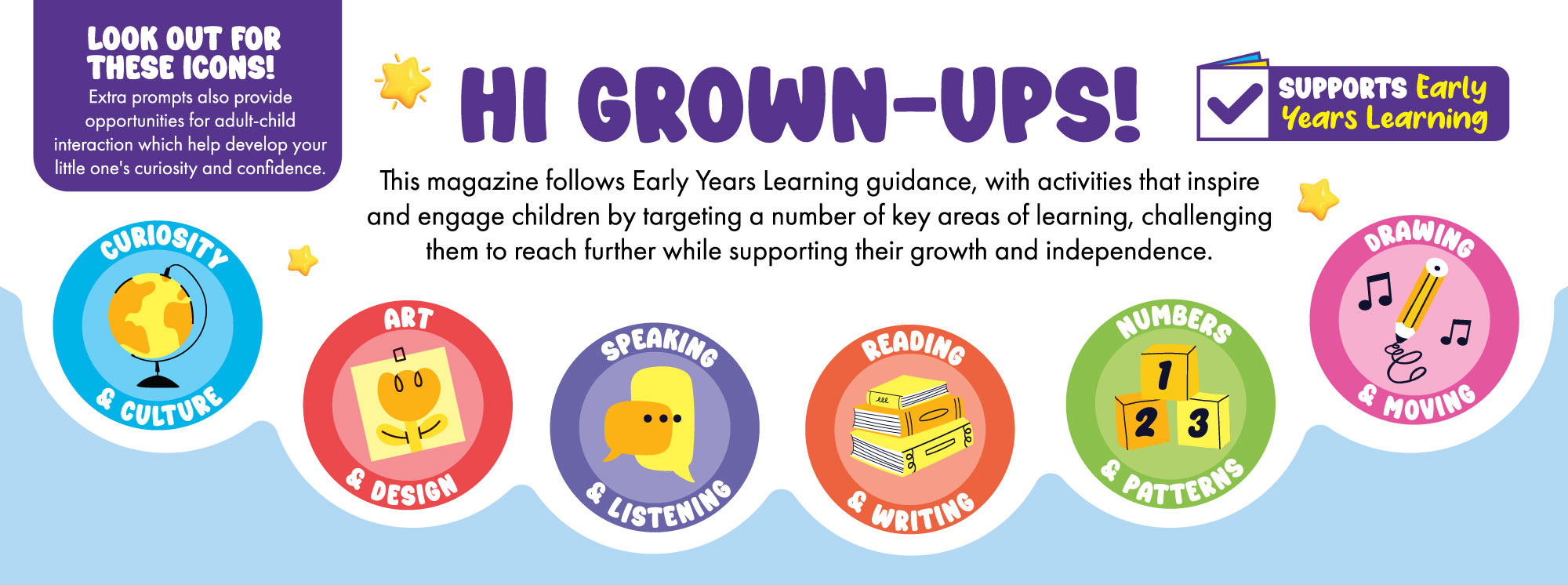
This panel is based on the government’s Early Years Foundation Stage (EYFS) curriculum. Many of our pre-school magazines use either this panel or a variation of it. Click here to see a list of all our pre-school titles. Our Early Years Learning (EYL) panel features at the beginning of a magazine, with symbols to signpost to grown-ups which activities will help their little one reach the relevant educational goals for their age. We also include extra prompts throughout that sometimes target a seventh key area of learning for Early Years: Personal, Social and Emotional Development (PSED).

Please click on each area of learning to discover more.

This symbol targets the EYFS curriculum’s ‘Understanding the World’ section. Pages with this icon will be targeting a child’s understanding of the world around them.

Pages with the Curiosity & Culture icon involve diverse facts and stories, along with any activities which enhance a child’s understanding of their community. Through these features, young readers learn about other cultures and areas of interest, which builds their knowledge while also expanding their vocabulary and reading comprehension.

This symbol targets the EYFS curriculum’s ‘Expressive Arts and Design’ section. Pages with this icon will target a child’s artistic and creative expression.

This can be expressed in many ways, including drawing, painting, cooking and performing. Art & Design pages encourage creative experimentation and sensory exploration within a child’s day-to-day life.

This symbol targets the EYFS curriculum’s ‘Communication and Language’ section. Pages with this icon will target a child’s spoken language development, and often require more hands-on interaction with a grown-up.

Children’s interactions, particularly back-and-forth exchanges with grown-ups, lay the groundwork for language growth. Adults can build their little one’s language skills by actively engaging with them in speaking, storytelling, and role play. They can also comment on children’s interests and showcase new vocabulary, which will help children become comfortable using a rich range of vocabulary in their speech.

This symbol targets the EYFS curriculum’s ‘Literacy’ section. Pages with this icon will be targeting reading skills and word recognition.

To support children’s development and love for reading and writing, it is essential to provide rich and varied reading experiences. This includes both fiction and non-fiction, as well as opportunities for shared discussions. These efforts lay the groundwork for children to become skilled readers and writers.

This symbol targets the EYFS curriculum’s ‘Mathematics’ section. Pages with this icon will be targeting a child’s mathematical and critical thinking skills.

By the end of pre-school, children generally need to count confidently and develop an understanding of numbers up to 10, including the relationships between them and the patterns within those numbers. This isn’t just done through numbers themselves, but also other areas like shapes, space, patterns and measures. It’s important to create positive attitudes and interest towards maths, along with creating an environment where children feel comfortable making mistakes and learning from them.

This symbol targets the EYFS curriculum’s ‘Physical Development’ section. Pages with this icon will be targeting a child’s motor skill development.

Gross and fine motor skills play a big role in early childhood development. Children begin with sensory exploration, then start developing gross-motor skills, which are bigger movements involving core strength, balance, spatial awareness, and coordination. Once gross-motor skills begin developing, the child moves on to their fine-motor skills, which are smaller movements involving hand-eye coordination and precise control of tools.

There is a seventh Early Years area of learning: Personal, Social and Emotional Development (PSED).

Supporting children’s personal, social and emotional development sets them up for school and beyond. This is done by nurturing positive relationships, teaching essential life skills, and providing opportunities for social interaction and emotional regulation.

We support PSED development through our adult-led call outs, which appear throughout our magazines. These call outs provide prompts which encourage children to process emotions, learn to resolve conflict and develop their relationship with grown-ups through open-ended discussions and extra activities.

These call outs also help introduce children to ideas like taking care of their bodies, managing their personal needs independently, and learning key social skills. Wherever possible, we try to adjust the language so that the adult is a co-learner rather than an instructor. This will provide more opportunities for the child to direct their own learning experiences.

Primary and Pre-teen

The Good Play Guide’s research states that 74% of parents agree that magazines encourage their children to engage with reading materials and soft learning exercises*.

Sadly, the National Literacy Trust states that just two in five children aged 8-18 said they enjoy reading in 2023. Considering these statistics, we are dedicated to helping children, particularly reluctant readers, discover the joy of reading through magazines, as well as helping improve their chances of reaching the expected reading level for their age group.

Our primary and pre-teen magazines target the key areas of learning for Key Stage 2 and 3 by utilising government frameworks. Older children may shy away from more explicitly educational magazines, but The Good Play Guide reports that 76% of parents agree that through the tactile use of magazines and play resources, children gain hands-on learning experiences*. Therefore, we carefully create content using popular trends, brands and topics that children find interesting to ensure they are engaged whilst benefitting from the learning opportunities within the magazine.

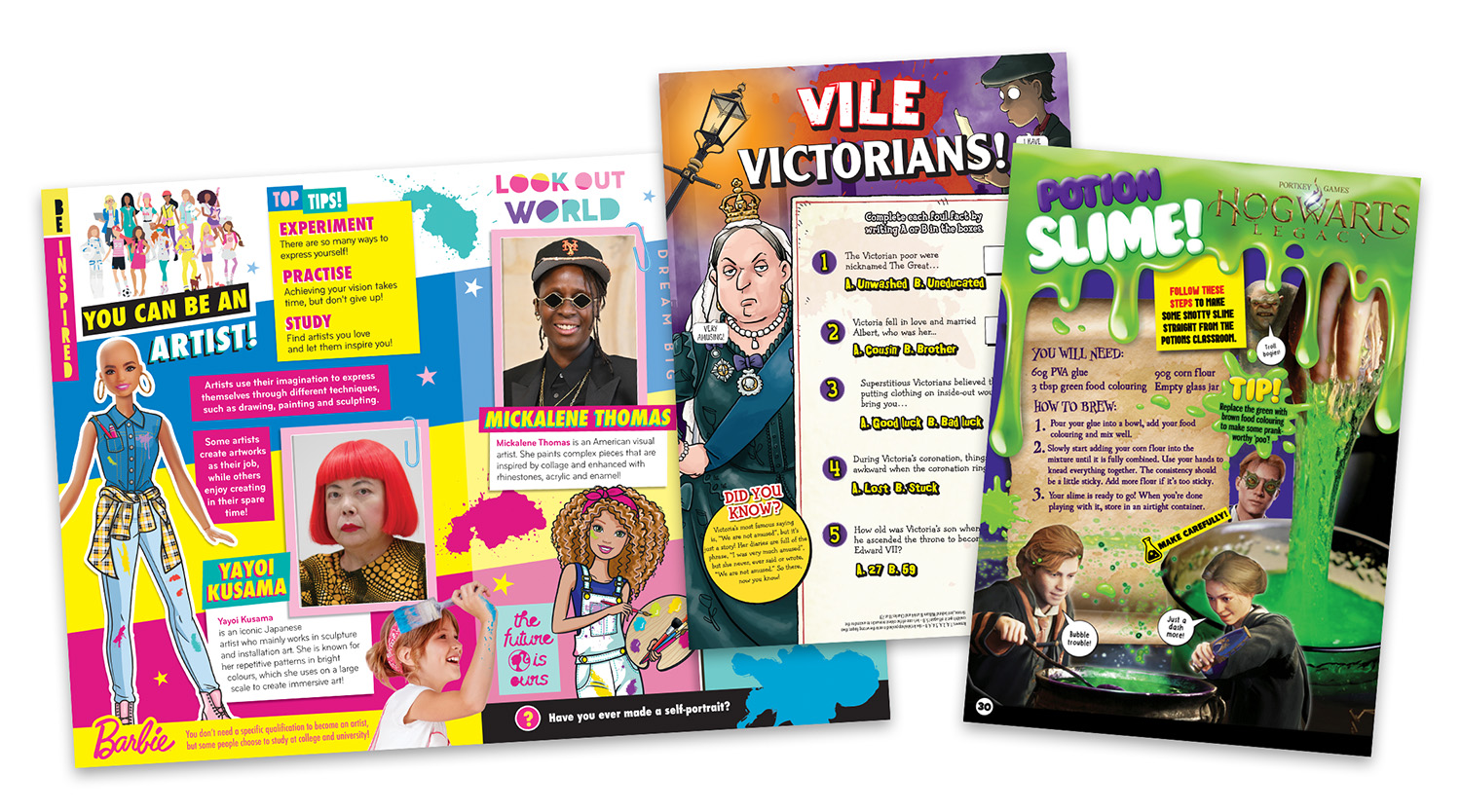
Magazines can continue providing the building blocks children need to support their learning with fun and engaging activities, whilst not explicitly feeling like schoolwork. Our titles support this in many ways. Horrible Histories magazine uses humour to reinforce subjects and themes children will be learning in History. Barbie magazine contains a dedicated careers chapter every issue to provide children with aspirational career learning opportunities. These learning opportunities will be tailored to individual titles and can often encourage further exploration of topics children may not have access to outside of the classroom, such as kitchen science experiments or craft-making.


*Author, FUNdamentally Children/Good Play Guide, 2024

Our primary and pre-teen magazines target the key areas of learning for Key Stage 2 and 3 by utilising government frameworks. Older children may shy away from more explicitly educational magazines, but The Good Play Guide reports that 76% of parents agree that through the tactile use of magazines and play resources, children gain hands-on learning experiences. Therefore, we carefully create content using popular trends, brands and topics that children find interesting to ensure they are engaged whilst benefitting from the learning opportunities within the magazine.

Magazines can continue providing the building blocks children need to support their learning with fun and engaging activities, whilst not explicitly feeling like schoolwork. Our titles support this in many ways. Horrible Histories magazine uses humour to reinforce subjects and themes children will be learning in History. Barbie magazine contains a dedicated careers chapter every issue to provide children with aspirational career learning opportunities. These learning opportunities will be tailored to individual titles and can often encourage further exploration of topics children may not have access to outside of the classroom, such as kitchen science experiments or craft-making. 

Barbie magazine contains a dedicated careers chapter every issue to provide children with aspirational career learning opportunities.

Horrible Histories magazine uses humour to reinforce subjects and themes children will be learning in History.

Further exploration of topics children may not have access to outside of the classroom, such as kitchen science experiments or craft-making. 

Covermounts

The Good Play Guide have conducted extensive research on the educational benefits of our magazines and covermounts. They reported that 68% of parents agreed that covermount toys help children, particularly those with additional needs and reluctant learners, to be more engaged with the content of the magazine*.

Young children need encouragement and support to reach their full potential and our magazines and covermounts can help them on this journey, whilst also developing their self-regulation, self-expression, and understanding by learning through play.

In line with our educational goals for our magazines, we aim to ensure our covermounts also complement the Early Years key areas of learning. We have implemented increased interactivity between the covermount and the magazine content by utilising gift callouts and activity suggestions, to highlight how gifts add value to the learning experience of magazines. We aim to provide toys and materials that encourage hands-on exploration, sensory experiences and support the development of key learning skills, whilst also ensuring that their durability and play-value are retained.
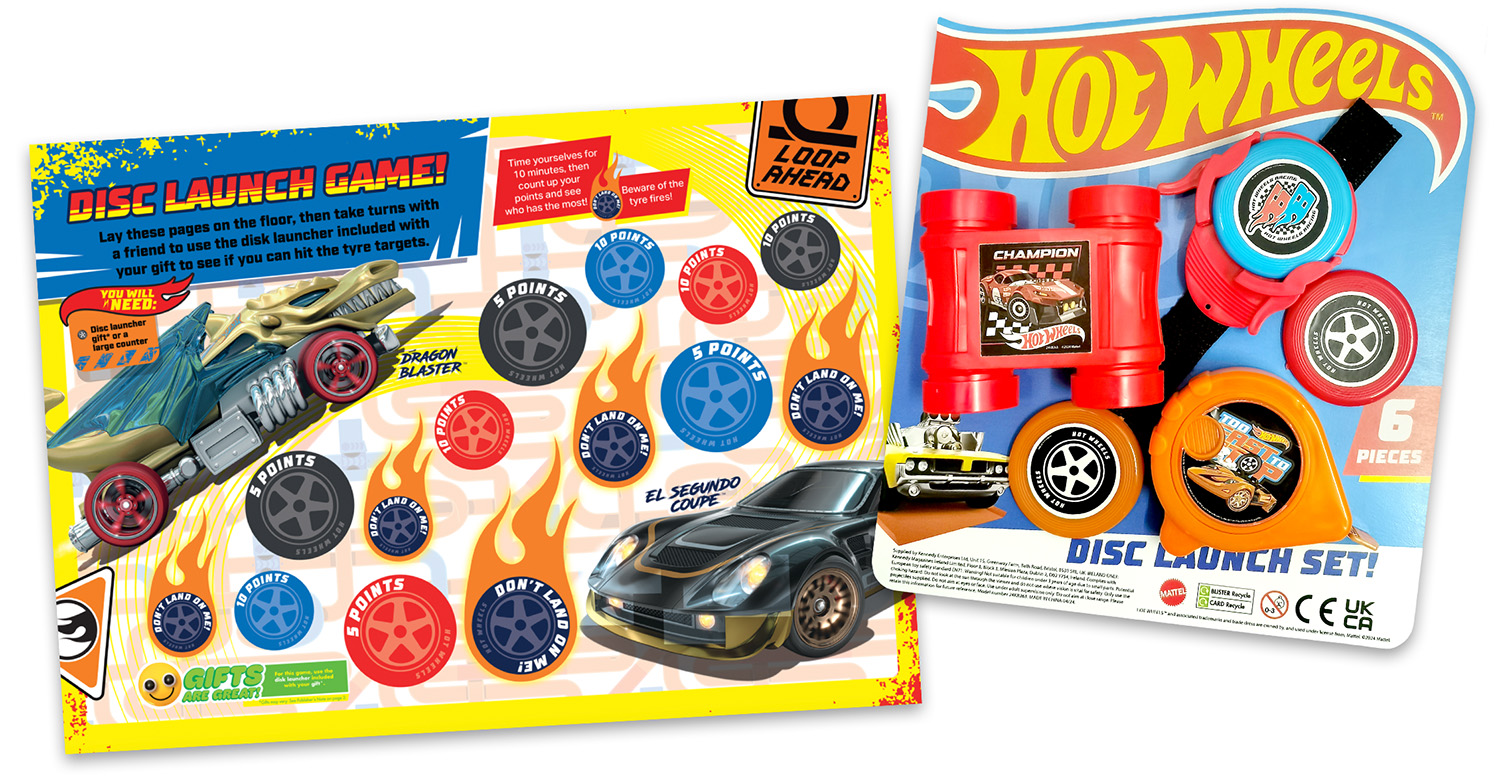
By combining magazines with toys, our products support all kinds of child development in one package, from reading to hand-eye coordination to social play. We’ve been developing the ways in which we relate our magazine activities to our toys and thinking about how we can utilise them as part of the reading, crafting and play opportunities inside, to provide a holistic experience that gets children learning, creating and moving in new, fun ways.

*Author, FUNdamentally Children/Good Play Guide, 2024
Glossary

You might see some words in our magazines, particularly our adult call outs, which use terms that you are unfamiliar with.

These terms tie directly in with different aspects of the EYFS and primary curriculum. We’ve put together a list which provides definitions for these words and concepts.

Alliteration: When a consonant sound is at the beginning of words in close succession. (e.g. pretty pink pigs)

Blending: Being able to listen to sounds spoken individually and push them together to blend them into one word. (e.g. saying c, a, t to make cat)                             

Co-ordination: The brain’s ability to control different body part movements at the same time.

Differentiation: Tailoring activities to meet individual needs. This means making sure that every reader is appropriately challenged regardless of their ability level. One way to do this is by creating a main activity that is accessible to everyone, with a small portion of the activity challenging more advanced readers, alongside introductory instructions for less advanced readers.

Early Learning Goals: A set of framework guidelines that details the skills that a child should generally have by the time they enter primary school. These are incredibly helpful when figuring out which activities will be accessible and/or challenging for a EYFS child.

Early Years Foundation Stage: Otherwise known as EYFS, this sets standards for the learning, development and care of English children from birth to 5 years old. All schools and Ofsted-registered early years providers must follow the EYFS. There are also different early years standards in England, Scotland and Wales.

Fine motor skills: Physical movement involving the smaller muscles of the fingers, hands, and wrists. Fine motor skills are used to do things like writing, cutting, building using small parts, threading beads, etc.

Gross motor skills: Skills involving larger muscles and/or your whole body to develop core strength. These could include kicking, running, jumping, pivoting with your whole body, etc.

Growth mindset: Believing that your brain and body can learn to do new things with time and practise. This encourages children to keep trying and to not see failure as a bad thing.

High frequency words: Words that a child comes across frequently in reading and writing. They may not be able to sound them out, but they should be able to recognise them by sight.

Irregular words: Also known as common exception words, these are words in which one or more letters do not represent their most common phonic sounds. Examples of these include you, the, two and eyes.

Self-directed play: A type of learning where children are allowed their own interests and ideas without being told what they should be doing.

Sensory exploration: Any type of play that engages one or more of a child’s senses, primarily the sense of touch.

Sound buttons: Marks that are made when building or reading a word to identify sounds in the word.

Further Links

To further support your child’s educational journey, we’ve compiled a selection of resources tailored to parents and educators. These links offer expert advice, practical tips and government guidance on children’s development and pedagogy. 

GENERAL

EARLY YEARS

PRIMARY

STEVE BROWN

Finance Director

He may be the new kid on the block after joining Kennedy in May 2021, but Steve’s career as a qualified accountant spans more than a quarter of a century and has seen him working in the retail and publishing sectors. Steve stays informed of the financial climate and market trends to help create strategic plans for Kennedy’s future.  

Steve loves nothing more than watching a cricket match and is currently planning ways to escape from the reptiles that are taking over his home, thanks to his children.  

Sophie Rowlands 

Licensing Director

Creative and commercially minded, Sophie has overseen the growth of the Kennedy portfolio from 10 licences to over 30. Since joining the company in 2015, she has acquired an in-depth knowledge of pre-school, primary and pre-teen brands, building strong and strategic relationships with key licensors across these sectors.  

Sophie’s expertise within the industry is exceptional and she is passionate about bringing children their favourite licensed brands and characters in a magazine format. Away from the office, Sophie loves nothing more than cuddling up on the sofa with her naughty sausage dog Wallace.  

Harry Ford 

Operations Director

Joining Kennedy in 2011 after leaving school, Harry’s drive and passion has seen him work his way up from Office Administrator to becoming Operations Director in 2019. Over the years Harry has helped to create a company strategy that is focused on growth, and he is very proud of the fun, educational magazines that the company continues to create. 

When he’s not achieving his goals at work, Harry is hoping to hit the back of the net on either the football or hockey pitch. A huge fan of Chelsea FC, he is still coming down from the excitement of them winning the 2021 UEFA Champions League Final. 

Daisy Li 

Purchasing Director

Move over Santa, because Daisy is an expert when it comes to finding the perfect gift for each title. Spending the last decade in the covermount team at Kennedy has given her the skills and contacts to ensure each publication stands out from the crowd.  

As a mother of two young boys, Daisy has the inside scoop on what children want from their favourite magazines. She loves seeing how little surprises can make a child’s day – it’s Daisy’s way of sprinkling a little bit of magic over the Kennedy publications.  

dean barber

Managing Director

With a career in publishing spanning more than 25 years, Dean has brought his passion for producing exciting, innovative, and customer-focused titles to Kennedy. He joined the company in April 2018 and his commitment, positivity, and occasionally humorous approach are infectious to those who work with him. 

Dean is a self-confessed sports fan, especially when it comes to his favourite team – Leicester City Football Club. He is, however, just as happy watching the thrills and spills of the F1 Grand Prix as he is playing a sedate game of golf.